

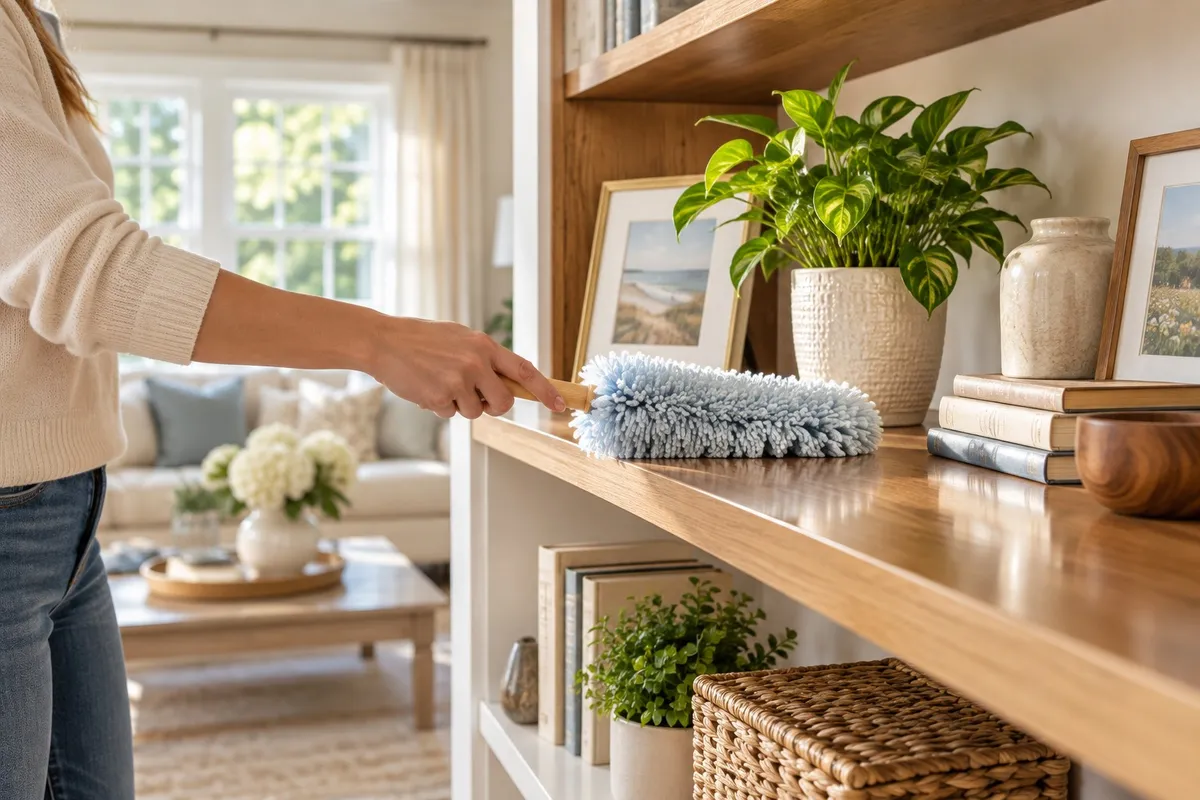
How to dust your home so the dust stays gone longer
To dust your home, start at the highest point in each room and work down, using a microfiber cloth that's dry or barely damp. Fold the cloth into quarters and turn to a clean side as each one fills. Dust before you vacuum, so whatever falls to the floor gets picked up last instead of settling back on the furniture.
What do you need to dust a house?
- Four to six microfiber cloths. One gets dirty fast, and a dirty cloth just spreads dust around.
- A spray bottle of plain water
- A microfiber duster on an extendable handle, for fan blades and the tops of door frames
- A vacuum with a soft brush attachment and a crevice tool
- A soft paintbrush or clean makeup brush, for carved wood, lamp bases and electronics
- Wood polish or conditioner, used once a month at most, and leather conditioner if you have leather furniture
Skip the feather duster. It lifts dust into the air, and it comes back down on whatever you just finished. Skip dusting sprays as an everyday habit too. Many leave a film that grabs new dust faster.
How do you dust a room step by step?
- Open the blinds and turn the lights on. You can't dust what you can't see. Low, sideways light from a window shows every streak.
- Start high. Ceiling fan blades, light fixtures, the tops of door frames, crown molding and the top of tall furniture. For fan blades, slide an old pillowcase over each blade and pull it back toward you. The dust stays inside the case instead of raining onto the bed.
- Work around the room in one direction. Pick a starting point and go clockwise. It stops you from missing a shelf or doing one twice.
- Then the middle. Shelves, picture frames, lamps, the TV stand, dressers and nightstands. Lift each object, wipe under it, wipe the object, put it back.
- Then low. Window sills, chair legs, baseboards and the lower shelves.
- Vacuum last. Floors, then the edges with the crevice tool, then under the bed and sofa as far as you can reach.
For a normal living room or bedroom, plan on 15 to 20 minutes for the dusting alone. The first time you do the high spots, add another 10.
How do you use a microfiber cloth for dusting?
Fold it in half, then in half again. That gives you eight clean faces. Wipe in straight lines, not circles, and lift the cloth off the surface at the end of each pass instead of dragging it back.
Use it dry on electronics, picture glass and anything with a delicate finish. On wood tables, shelves and hard surfaces with real buildup, mist the cloth (not the furniture) with plain water until it's barely damp. Damp fibers trap fine dust that a dry cloth leaves behind.
When the cloth looks gray, switch to a fresh one. Wash them on their own afterward, with no fabric softener, because softener coats the fibers and they stop grabbing dust.
How do you dust and polish wood furniture?
Dust wood the same way as everything else: a barely damp cloth, then a dry one, following the grain.
Polish is a separate, occasional job. Once a month at most, put a small amount of wood polish on a cloth, not on the table, and work it in along the grain. Buff it off with a clean, dry cloth. Too much polish, too often, builds a sticky layer that holds dust and fingerprints and dulls the finish.
A few things to keep away from wood: wet cloths, all-purpose sprays, vinegar and anything with ammonia. If you see a white ring or a cloudy patch, stop wiping and let it dry. Rubbing harder makes it worse.
What about leather, metal and glass?
- Leather: a dry or very lightly damp cloth for dust. A leather conditioner once or twice a year keeps it from cracking. Test a hidden spot first.
- Metal and hardware: a dry microfiber cloth. Polish brass or chrome only when it looks dull, and buff it dry so it doesn't spot.
- Glass tabletops and picture glass: dust them dry first, then use a glass cleaner or a 50/50 mix of white vinegar and water on a cloth. Wiping a dusty glass top wet just makes mud streaks.
- Electronics: turn them off and use a dry cloth or a soft brush. No sprays on screens.
How do you dust a bedroom?
Sheets, pillows and blankets shed fibers every night.
- Strip the bed before you dust. Shaking out sheets and pillowcases throws dust onto every surface you just cleaned. Strip first, dust, then make the bed with clean sheets.
- Wash sheets weekly in the hottest water the care label allows.
- Vacuum the mattress with the upholstery tool once a month, when you change the sheets.
- Pull the nightstand away from the wall every few weeks. Behind it is where the cords, the dust and the lost earrings live.
- Dust the headboard, especially fabric or tufted ones. Use the vacuum's brush attachment.
How do you keep dust from coming back so fast?
You can't stop dust, but you can slow it down.
- Change the HVAC filter on the schedule the manufacturer gives, and more often during pollen season.
- Put a washable mat at every outside door and take shoes off inside.
- Vacuum upholstered furniture and curtains with the brush attachment once a month.
- Keep fewer things out on open shelves. Every object is one more thing to lift and wipe.
- Brush pets outside when you can.
For the spots that get missed even in clean homes, see our list of commonly missed cleaning spots, and for slat-by-slat help, how to clean window blinds.
What dusting is included in a house cleaning?
On a Standard House Cleaning, RoutineCare, reachable surfaces and furniture are dusted, mirrors and glass surfaces are cleaned, window sills are wiped and floors are vacuumed and mopped. Counters, shelves and tables get wiped where they're clear of clutter.
The high and low spots are where Deep Cleaning, PureRenewal, comes in. Dusting includes décor and picture frames, reachable ceiling fans and light fixture exteriors are cleaned, cobwebs are removed, blinds are dusted, baseboards are hand wiped, and under and behind furniture that moves easily is cleaned. Every item on the list is done whether or not it looks like it needs it.
Anything that needs a ladder above a two-step stool isn't part of either one.
If you want the dusting kept up without thinking about it, Standard House Cleaning can be booked one time, weekly, every other week, every 4 weeks or twice a year. See Recurring House Cleaning, RoutineCare Plans.
FAQ
Should you dust or vacuum first? Dust first, vacuum last. Dusting knocks particles onto the floor, so vacuuming at the end picks up what fell instead of leaving it to settle back on the furniture.
What should you dust with? A microfiber cloth, dry or very lightly dampened with water, picks up dust and holds it. Feather dusters and dry cotton rags mostly move dust into the air, where it settles again on the next surface.
How often should you dust your house? Once a week for the surfaces you see and touch, and once a month for the high and low spots like ceiling fans, door tops, baseboards and the top of the fridge. Homes with pets, open windows or construction nearby need it more often.
Why does my house get dusty so fast? Household dust is a mix of skin flakes, fabric fibers, pet dander, pollen and dirt tracked in from outside. Bedding, rugs and upholstery hold a lot of it, so washing sheets weekly, vacuuming fabric and changing the HVAC filter on schedule slow it down.
Does a house cleaning include dusting? Yes. Standard House Cleaning dusts reachable surfaces and furniture. Deep Cleaning adds décor and picture frames, reachable ceiling fans and light fixture exteriors, cobwebs, blinds and hand-wiped baseboards.
Book a cleaning
We clean homes across South Jersey and Central Jersey. Book online at tinascleanteam.com/book-now, or call or text (609) 831-4455.
